NASA Launches Spherex Telescope to Map Cosmic Glow
The $488 million Spherex observatory has launched on a mission to map the entire sky in infrared, aiming to reveal how galaxies formed and evolved since the Big Bang.
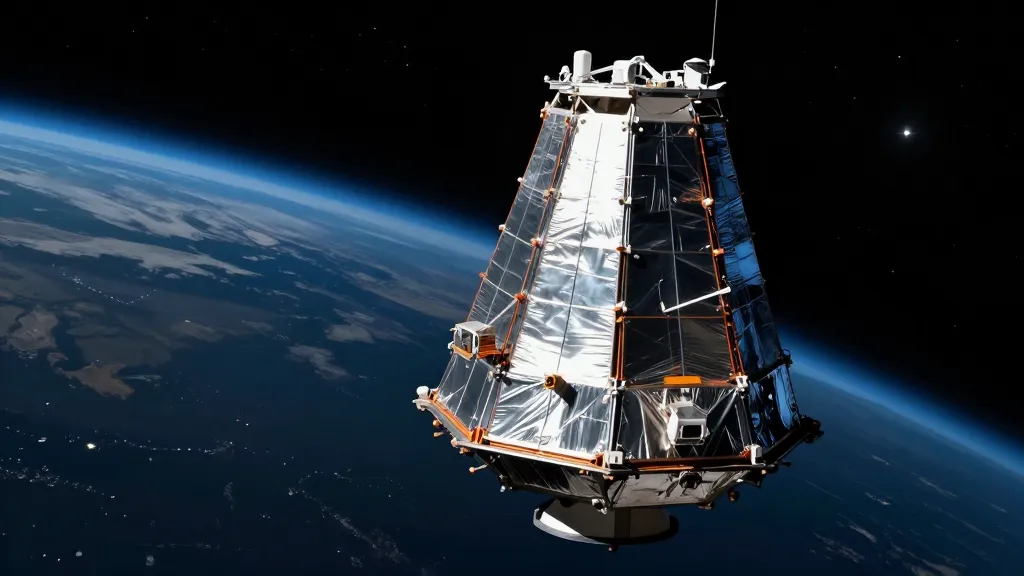


- Spherex is a $488 million NASA telescope launched on Tuesday to map the entire sky in infrared.
- The mission aims to study galaxy formation, evolution, and the rapid expansion of the early universe.
- Unlike Hubble or Webb, Spherex observes the collective 'cosmic glow' of all galaxies rather than individual objects.
- The telescope will conduct four full-sky surveys over two years from a 650-kilometer polar orbit.
- Four PUNCH satellites were also launched to study the sun's corona and solar wind.
NASA’s newest space telescope, Spherex, successfully launched into orbit on Tuesday from Vandenberg Space Force Base in California. The observatory, carried by a SpaceX Falcon rocket, is designed to map the entire sky, providing an unprecedented view of hundreds of millions of galaxies and their collective cosmic glow.
The $488 million mission aims to answer fundamental questions about how galaxies formed and evolved over billions of years, as well as why the universe expanded so rapidly in its earliest moments. Unlike the Hubble and Webb telescopes, which focus on individual objects with high resolution, Spherex will observe the total infrared light emitted by all galaxies combined.
"This cosmological glow captures all light emitted over cosmic history," said Jamie Bock, the mission’s chief scientist at the California Institute of Technology. "It’s a very different way of looking at the universe," allowing researchers to detect sources of light that may have been missed by previous instruments.
Weighing 500 kilograms and shaped like a cone, Spherex will operate in a polar orbit 650 kilometers above Earth. Over two years, it plans to conduct four full-sky surveys using infrared detectors capable of distinguishing 102 colors invisible to the human eye. This data will create the most comprehensive color map of the cosmos ever produced.
Within our own Milky Way, the telescope will also search for water and other essential ingredients for life in the icy clouds where new solar systems are born. To maintain its sensitive infrared detectors at minus 210 degrees Celsius, Spherex features a unique three-layered aluminum-honeycomb shield that protects it from heat generated by the sun and Earth.
The launch, which was delayed by two weeks due to technical issues, also deployed four smaller satellites known as PUNCH. These suitcase-sized spacecraft will study the sun’s corona and solar wind from their own polar orbits.
Corrections: [email protected]